Best Water Shoes for Slippery Rocks
There is no slip-proof water shoe. For ordinary rocky access, consider secure closed-toe footwear with a documented water-oriented outsole, but change the route when algae, slope or current make footing unreliable.
Compare water-footwear designs for rock contact while understanding why algae, slope and current can defeat traction.
As an Amazon Associate, we may earn from qualifying purchases.
A slippery rock is not one surface
Dry coarse rock, polished stone and algae-covered ledges present different problems. A tread that feels dependable on one can lose purchase on another. The slope, depth of water and direction of your step also matter. That is why we do not award a universal “best grip” winner without controlled, surface-specific testing.
Start with the route. If falling would put you into current or over an edge, a shoe comparison is not enough to make the crossing reasonable. The National Park Service’s Obed guidance notes slippery rock surfaces, recommends closed-toe footwear and calls for careful entry and exit. It does not suggest that an outsole eliminates the hazard.
Compare construction, not confident adjectives
Columbia Drainmaker XTR is a candidate for mixed land-and-water use; its listing describes rubber traction areas with micro-siping. Those are relevant design details, but we have not tested its friction on algae-covered rock. Consider it alongside the route’s walking demands instead of translating “traction” into permission to take a risk.
Astral’s water-footwear range offers another route to investigate for water-oriented construction. The Loyak is a low-profile option, while more substantial river models have different coverage and bulk. Verify the exact model’s outsole information: a brand’s reputation should not substitute for the specification of the pair being purchased.
KEEN Newport H2 provides a closed-toe hybrid alternative. Its bumper and webbing change coverage and ventilation, not the laws of friction. Sandal openings admit debris, and a secure closure matters if the foot would otherwise slide inside the shoe even while the outsole remains planted.
Sole thickness answers a different question
A thicker sole can reduce the sensation of pointy stones and change how the shoe bends. It does not automatically create better grip. Rubber properties, tread contact and contamination play separate roles. Likewise, tall lugs designed to engage loose soil are not proof of excellent contact on a smooth slab.
If a product only advertises “non-slip” without explaining the intended use, treat that as insufficient detail. Look for manufacturer information about the outsole and compare realistic tradeoffs. You may prefer more underfoot protection for a rough approach, or less bulk for a short entry, while accepting that both require caution on wet rock.
Internal sliding can be mistaken for poor tread
A foot sliding across a wet insole can feel like the entire shoe slipped. Check heel hold and lateral movement using the fit guide. A closure that only tightens the forefoot while leaving the heel loose may not solve the problem. Stop to clear stones or sand rather than continuing with an unstable interface inside the shoe.
Inspect the outsole as well. Worn smooth areas, peeling rubber and embedded debris change the contact surface. Do not test grip by deliberately stepping onto a dangerous slope. Assess the shoe in low-consequence conditions, and reject a route when uncertain footing has serious consequences.
A conservative purchase and use plan
For a short rocky entry, prioritize adequate coverage and a shoe that stays aligned. For a longer approach, add walking comfort to the comparison. For technical river travel, seek footwear and instruction appropriate to that activity rather than treating a casual beach model as specialist equipment.
Finally, consider whether the entry can be moved to a maintained ramp or easier shore. That decision can provide more benefit than switching between two plausible outsoles. The sensible end point is not feeling invulnerable; it is choosing a manageable route and footwear whose limitations you understand.
Compare the product listings
Research-based options, not a hands-on test ranking. Confirm size, color and current availability on Amazon.
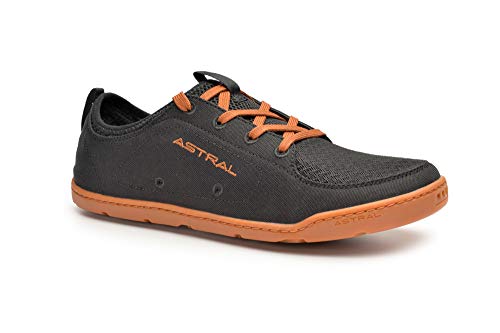 Men’s · Astral
Astral Loyak — Men
View on Amazon ↗Low-profile water sneaker for paddling and shore use.
Consider: Less cushioning than a structured walking shoe.
 Men’s · KEEN
KEEN Newport H2 — Men
View on Amazon ↗Closed-toe water sandal with adjustable retention for mixed shore and walking days.
Consider: Open sides let small stones and sand enter.
Questions about this topic
Are Vibram soles automatically best on algae?
No. A brand name or compound label does not establish performance on every contaminated surface, and algae can remain extremely slippery.
Do deeper lugs grip smooth wet rock better?
Not necessarily. Lugs and smooth-rock contact solve different traction problems; depth alone is not a useful ranking.
Can a toe bumper prevent a fall?
No. It offers coverage around the toes, not a guarantee of traction or balance.
Use footwear as one part of a conservative rocky-entry plan. Where a slip would have serious consequences, choose another route instead of relying on a “non-slip” claim.
Use the water shoe finder →Continue your research
For a broader comparison, use our water shoes finder and catalog.