 Men’s · ALEADER
ALEADER Quick-Drying Hiking — Men
View on Amazon ↗Covered water footwear to compare for the activities listed below.
Consider: Check the model’s size chart, closure and outsole before choosing.
Water shoes for hiking are a compromise between walking comfort and repeated wet use. Start with the length and roughness of the trail, then compare drainage and upper construction. A thin swimming shoe may be convenient at one crossing but poorly suited to carrying you through the rest of the route.
Read the full buying guide ↓As an Amazon Associate, we may earn from qualifying purchases.
Compare styles here, then select the exact size and color on Amazon. Availability and sellers can change.
Men’s · ALEADERCovered water footwear to compare for the activities listed below.
Consider: Check the model’s size chart, closure and outsole before choosing.
 Adult unisex · SITAILE
Covered water footwear to compare for the activities listed below.
Consider: Check the model’s size chart, closure and outsole before choosing.
Unisex listing: check the men’s/women’s size conversion on Amazon.
 Men’s · KEEN
Closed-toe water sandal with adjustable retention for mixed shore and walking days.
Consider: Open sides let small stones and sand enter.
 Men’s · Xero Shoes
Minimalist amphibious shoe for shoppers who already prefer a flexible, low-profile sole.
Consider: Not a cushioned substitute for a hiking boot.
 Adult unisex · Astral
Lace-up water sneaker to compare for paddling and wet approaches.
Consider: Confirm the listing’s adult size conversion before ordering.
Unisex listing: check the men’s/women’s size conversion on Amazon.
 Men’s · Teva
Adjustable open-toe sandal for warm-weather walking and easy water crossings.
Consider: Exposed toes make this a poor choice around sharp rock.
 Women’s · Dannto
Ventilated sandal construction for wet-to-dry outings.
Consider: Openings can admit grit; confirm heel security and toe coverage.
 Women’s · KEEN
Closed-toe water sandal with an adjustable bungee fit and open drainage.
Consider: The open sides admit sand and small stones; stop to clear them rather than walking through rubbing.
 Men’s · KEEN
Lower-profile closed-toe sandal for walking between wet and dry surfaces.
Consider: Less enclosed than a shoe; debris can enter through the side openings.
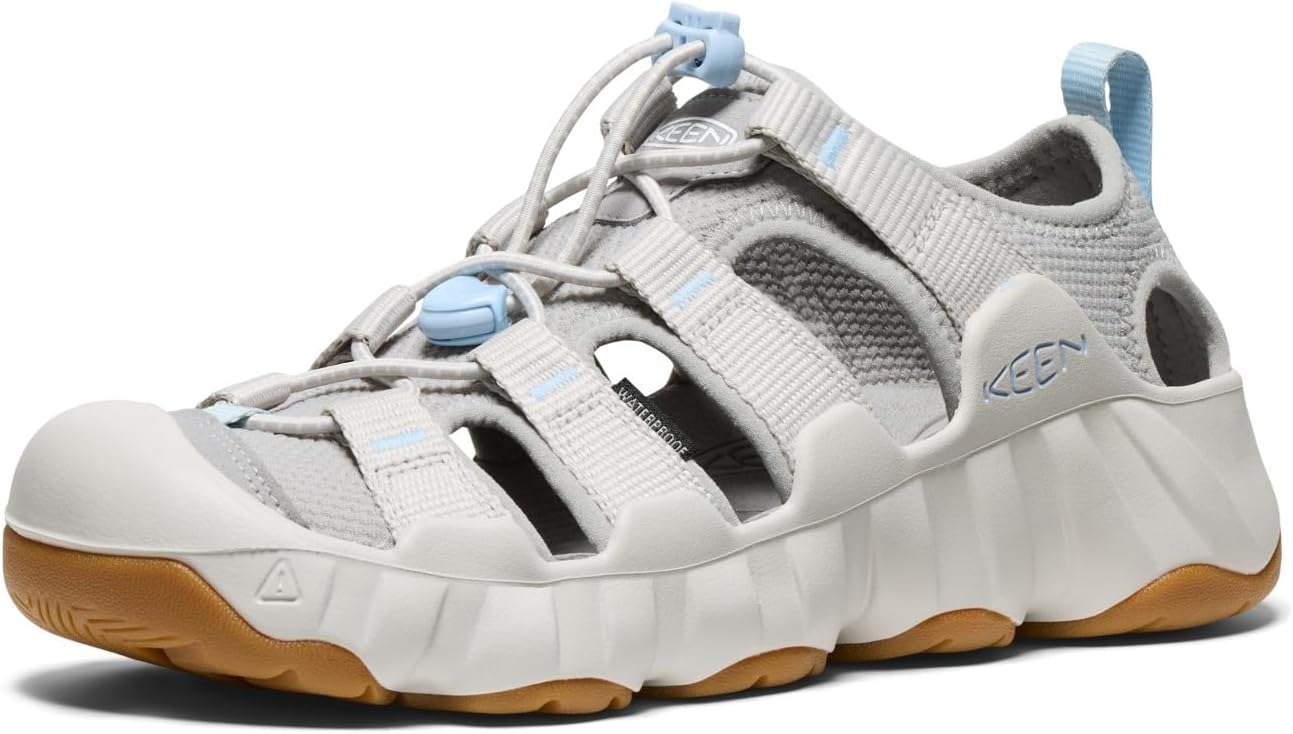 Women’s · KEEN
Women’s cushioned closed-toe water sandal for mixed walking and water days.
Consider: The substantial sandal platform takes more luggage space than an aqua sock.
 Women’s · KEEN
Women’s version of the Newport H2 with a covered toe and open sandal sides.
Consider: Use the women’s fit chart; do not assume the men’s version has the same shape.
 Women’s · KEEN
Women’s lower-profile closed-toe water sandal for shoreline walking.
Consider: Open sides simplify draining but cannot keep fine sand out.
 Men’s · Merrell
Amphibious hiking shoe for routes that alternate dry trail and water crossings.
Consider: More structured than a swim sock; choose it for the walking portion of the trip.
 Men’s · Merrell
Open-sided hiking-water design for shoppers deciding between a shoe and a sandal.
Consider: Compared with an enclosed upper, openings expose more of the foot to grit.
 Men’s · KEEN
Men’s cushioned water sandal with a covered toe for mixed shore and walking use.
Consider: Try the sole height and fit on uneven ground before committing to a longer route.
For an occasional water entry, changing from your normal hiking footwear may be practical at a suitable place. For frequent transitions, a shoe designed for mixed terrain can avoid repeated changes. Weigh that convenience against dry comfort and how the pair feels when damp.
Do not assume footwear makes a crossing acceptable. Route conditions need their own assessment, and turning back remains an option regardless of the shoe you selected.
Inspect the sole beneath the heel and forefoot, the upper’s hold around the midfoot, and any toe reinforcement. Try descending a gentle indoor incline to check for forward sliding. A roomy toe area is useful only if the rest of the shoe holds your foot adequately.
For a longer outing, consider the weight you will carry and your usual footwear preferences. A quick try-on may miss discomfort that becomes obvious after sustained walking, so start with a shorter route.
Mesh and drainage openings provide ways for water to leave but can also expose the interior to debris. Look for a shoe you can open and clear without a lengthy struggle. If you wear socks, fit the shoes with those socks and plan a dry spare as appropriate. Judge the whole trail system rather than buying solely on a quick-dry claim.