 Kids’ · KEEN
KEEN Newport H2 — Kids
View on Amazon ↗Ventilated sandal construction for wet-to-dry outings.
Consider: Openings can admit grit; confirm heel security and toe coverage.
Water-shoe sandals combine an open upper with a sole you can wear through wet activities. They are useful when easy rinsing and airflow matter, but the openings also admit grit. Compare strap placement, toe coverage, and footbed shape to decide whether a sandal fits your outing better than an enclosed shoe.
Read the full buying guide ↓As an Amazon Associate, we may earn from qualifying purchases.
Compare styles here, then select the exact size and color on Amazon. Availability and sellers can change.
Kids’ · KEENVentilated sandal construction for wet-to-dry outings.
Consider: Openings can admit grit; confirm heel security and toe coverage.
 Men’s · Crocs
Ventilated sandal construction for wet-to-dry outings.
Consider: Openings can admit grit; confirm heel security and toe coverage.
 Men’s · KEEN
Closed-toe water sandal with adjustable retention for mixed shore and walking days.
Consider: Open sides let small stones and sand enter.
 Kids’ · KEEN
Ventilated sandal construction for wet-to-dry outings.
Consider: Openings can admit grit; confirm heel security and toe coverage.
 Men’s · Grundéns
Open sandal for casual deck and shoreside use.
Consider: No heel retention: exclude it from swimming and moving-water recommendations.
 Kids’ · ChayChax
Ventilated sandal construction for wet-to-dry outings.
Consider: Openings can admit grit; confirm heel security and toe coverage.
 Men’s · Teva
Adjustable open-toe sandal for warm-weather walking and easy water crossings.
Consider: Exposed toes make this a poor choice around sharp rock.
 Adult unisex · KUKTO
Ventilated sandal construction for wet-to-dry outings.
Consider: Openings can admit grit; confirm heel security and toe coverage.
Unisex listing: check the men’s/women’s size conversion on Amazon.
 Kids’ · Stelle
Ventilated sandal construction for wet-to-dry outings.
Consider: Openings can admit grit; confirm heel security and toe coverage.
 Women’s · Dannto
Ventilated sandal construction for wet-to-dry outings.
Consider: Openings can admit grit; confirm heel security and toe coverage.
 Women’s · KEEN
Closed-toe water sandal with an adjustable bungee fit and open drainage.
Consider: The open sides admit sand and small stones; stop to clear them rather than walking through rubbing.
 Men’s · KEEN
Lower-profile closed-toe sandal for walking between wet and dry surfaces.
Consider: Less enclosed than a shoe; debris can enter through the side openings.
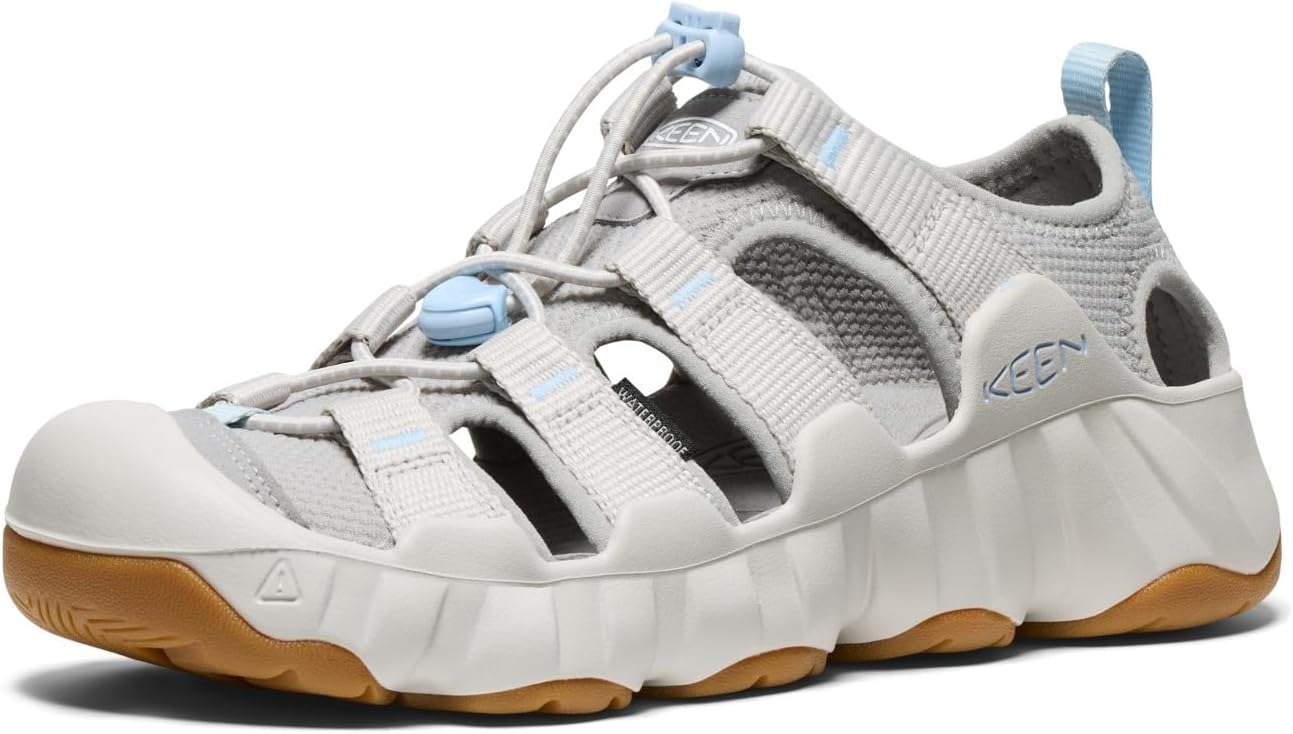 Women’s · KEEN
Women’s cushioned closed-toe water sandal for mixed walking and water days.
Consider: The substantial sandal platform takes more luggage space than an aqua sock.
 Women’s · KEEN
Women’s version of the Newport H2 with a covered toe and open sandal sides.
Consider: Use the women’s fit chart; do not assume the men’s version has the same shape.
 Women’s · KEEN
Women’s lower-profile closed-toe water sandal for shoreline walking.
Consider: Open sides simplify draining but cannot keep fine sand out.
 Men’s · Merrell
Open-sided hiking-water design for shoppers deciding between a shoe and a sandal.
Consider: Compared with an enclosed upper, openings expose more of the foot to grit.
 Men’s · KEEN
Men’s cushioned water sandal with a covered toe for mixed shore and walking use.
Consider: Try the sole height and fit on uneven ground before committing to a longer route.
Some sandals adjust at the forefoot, instep, and heel; others offer only one moving strap. Identify the area where ordinary sandals tend to feel loose or tight, then choose a closure that addresses it. A strap elsewhere may not solve that fit problem.
Walk with the straps comfortably snug rather than cinched as tightly as possible. Notice whether the foot slides over the edge of the platform or whether a strap crosses a sensitive spot.
Open toes give a clear view of the forefoot and make debris easy to spot. A covered front puts material between your toes and obstacles, although the degree of protection depends on the construction. Either version can collect pebbles beneath the foot.
If your destination requires closed-toe footwear, check the actual wording before assuming a closed-toe sandal qualifies. A side opening can matter to an operator even when the front is covered.
A substantial sandal may be comfortable for a mixed walking-and-water day, but judge the footbed on your own foot. Raised contours and textured surfaces feel different from a flat liner. Try several minutes of indoor walking before keeping the pair. At the end of an outing, open the straps and clear grit from the fastening so you can inspect how securely it closes next time.