Best Barefoot Water Shoes
Astral Loyak and Loyak AC are useful starting points for a minimalist water shoe shortlist. Choose a flexible, level platform for ground feel only if it remains comfortable on your actual route; a barefoot label does not guarantee a wide fit or protection from sharp objects.
Compare barefoot water shoes for paddling, beach trips and everyday summer wear, including the protection you give up for flexibility.
As an Amazon Associate, we may earn from qualifying purchases.
What earns a place on this shortlist
Barefoot water footwear should let the forefoot bend and the toes sit naturally, without a raised heel dominating the stance. Water performance is a separate requirement: a flexible gym shoe with absorbent padding can still be a poor choice after immersion. We consider how a model is constructed and where that construction makes sense. These are research-based comparisons, not claims that we personally tested every shoe.
Treat minimalism as a preference rather than a performance award. A very thin sole makes a paddleboard easier to feel underfoot, but the same shoe may leave you wishing for more protection on the gravel road from the parking area. Decide how much of the day happens outside the water before choosing the lightest option.
Astral Loyak: the water-to-town candidate
The Loyak belongs on the list for someone who wants a low-profile water sneaker that also looks ordinary enough for lunch after paddling. Astral includes it in its men's water-shoe range, alongside more substantial river footwear. Its appeal is versatility and a flexible feel rather than the support of a hiking sandal.
The practical compromise is underfoot isolation. If your beach visit includes rough access paths, compare the sole against a more protective model before committing. A shoe can feel beautifully unobtrusive on a smooth deck and noticeably demanding on pointed gravel. Check the current men's or women's size chart instead of assuming the shared model name means identical sizing.
Astral Loyak AC: compare the upper, not just the name
Loyak AC is a separate model worth comparing when water use matters more than a casual sneaker appearance. Its breathable mesh-oriented design distinguishes it from the standard Loyak. Look closely at the actual listing because a color change in the ordinary Loyak is not the AC version.
For frequent soaking, an open upper can make the shoe less cumbersome after exiting the water. The other side of that choice is exposure to fine debris. If your route involves silty river edges or loose sand, plan to empty the shoe when particles get inside instead of assuming a close fit will keep every grain out.
Reading less familiar barefoot listings
Some inexpensive aqua shoes use barefoot as a broad marketing term. A photograph cannot establish heel-to-toe geometry, actual internal width, or how the sole flexes. Look for an explicit construction description and a usable size chart. If a listing only repeats swimming, running, hiking and yoga without describing the shoe, those activity words are not evidence of equal suitability for all four.
Count one model once. Different sizes and colors may have separate product identifiers, but they do not create a meaningful comparison. More useful distinctions are a lace-adjusted upper versus an elastic collar, a continuous rubber sole versus drainage openings, and a thin water sock versus a structured sneaker.
Make the first outing an easy one
If you normally wear cushioned shoes, begin with a short outing close to an easy exit rather than an all-day rocky excursion. Choose familiar ground and notice whether you change your stride to avoid pressure. Discomfort is a reason to shorten the outing or choose another shoe; it is not proof that the shoe is improving your feet.
Check the interior after the first wet session. An insole that folds, a heel that rotates, or a seam that rubs can matter more than the sole's advertised flexibility. Do not cut away structural parts to force a barefoot feel. Keeping a comfortable walking pair available gives you the freedom to use minimalist shoes where you actually enjoy them.
Compare the product listings
Research-based options, not a hands-on test ranking. Confirm size, color and current availability on Amazon.
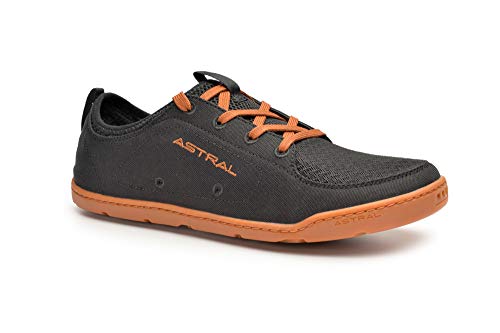 Men’s · Astral
Astral Loyak — Men
View on Amazon ↗Low-profile water sneaker for paddling and shore use.
Consider: Less cushioning than a structured walking shoe.
Questions about this topic
Are all thin aqua socks barefoot shoes?
No. Thinness alone says little about internal toe shape, heel height or secure retention. Compare the construction rather than the label.
Is Loyak AC just another Loyak color?
No. It is a separate model with a more mesh-oriented upper. Confirm the exact model name when comparing listings.
Can a barefoot water shoe replace a hiking boot?
Only on outings where its limited protection and support suit you. Rough trails, heavy loads and long approaches may call for more substantial footwear.
Start with Loyak for a casual-looking crossover and compare Loyak AC for a more water-focused upper. Choose more sole if your route demands it; minimal weight is not the only useful measure.
Use the water shoe finder →Continue your research
For a broader comparison, use our water shoes finder and catalog.