Best Water Shoes for Kayaking
Choose kayaking shoes that fit your boat’s foot space and remain clear of the exit path. Astral Loyak is a low-profile candidate; NRS wetshoes address different paddling needs. Match cold-water protection separately to immersion conditions.
Kayaking footwear choices organized around cockpit room, rocky launches and cold-water preparation.
As an Amazon Associate, we may earn from qualifying purchases.
Start inside the boat
Sit in the kayak on shore with the intended footwear and your usual paddling clothing. Adjust the foot braces as you normally would, then check whether your feet can move freely. A bulky sole or prominent fastening can be inconvenient in a small cockpit even if the shoe is comfortable when standing.
The boat type changes the calculation. A roomy sit-on-top does not impose the same constraints as a close-fitting cockpit. Pedal systems add another interface to inspect. Follow the boat maker’s guidance and practise exits and rescue skills with qualified instruction; footwear should support the established procedure rather than create a new obstruction.
Low-profile option: Astral Loyak
Loyak is a relevant candidate when reduced bulk and a water-oriented shoe are priorities. It is already a recognizable model in the site’s catalogue, so additional colours should not masquerade as a larger selection. Compare the actual shape with the available foot space, not simply a claim that it is a “kayaking shoe.”
Its low-profile approach has a tradeoff: if the launch involves a lengthy rough carry, you may want more underfoot structure. A shoe can work well inside the boat and still be less comfortable on the path to it. Count the carry distance before committing to a compact design.
Wetshoe option: NRS Kicker
NRS Kicker Wetshoe belongs to the paddling-specific wetshoe category. It is worth examining when a neoprene-style construction fits the outing better than an airy mesh sneaker. Confirm the exact thickness, size and sock combination in the current manufacturer information rather than assuming all NRS footwear is identical.
A wetshoe is not a complete cold-water clothing system. NRS advises preparing for immersion and dressing for water conditions. Warm air on shore is not enough reason to rely on summer mesh footwear during a cold-water outing. Decide the thermal system first, then ensure the shoe accommodates it without compression.
More shore structure can be useful
A closed-toe hybrid such as KEEN Newport H2 may appeal for casual paddling with substantial time walking ashore, provided it fits the boat and remains secure. Its open sides make rinsing straightforward but can admit stones. The more substantial shape is the reason to test cockpit compatibility carefully.
For a launch involving sharp or coarse surfaces, look at coverage and ordinary abrasion protection. No casual shoe should be described as hook-proof or puncture-proof without evidence. Choosing a better launch can be more sensible than expecting footwear to compensate for a poor access point.
Loose components deserve attention
Secure laces, tabs and cords as the manufacturer intends. Inspect the space around pedals and braces rather than focusing only on toe length. If changing footwear also changes how your legs sit, revisit the boat setup on shore. Do not wait until a difficult landing to discover that the new pair presses against an edge.
Wet fit still matters, but avoid repeating a generic sizing rule: use the dedicated fit guide. If you wear drysuit socks or another substantial layer, include them in the trial. Additional fabric can alter both volume and movement even when the nominal shoe size stays the same.
Keep an exit pair and a drying plan
For a long day, dry footwear for the drive home can be a worthwhile comfort item. After paddling, clear sediment from the shoe and open it for drying. Neoprene, mesh and padded linings will not necessarily dry at the same rate, particularly in a humid campsite.
A practical kayaking choice is therefore a three-part match: the boat, the launch and the water conditions. A recommendation based only on the word “kayaking” misses the most important differences between outings.
Compare the product listings
Research-based options, not a hands-on test ranking. Confirm size, color and current availability on Amazon.
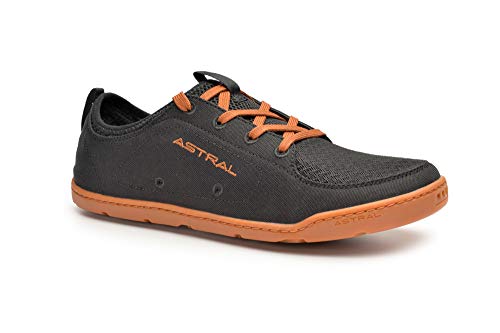 Men’s · Astral
Astral Loyak — Men
View on Amazon ↗Low-profile water sneaker for paddling and shore use.
Consider: Less cushioning than a structured walking shoe.
 Men’s · KEEN
KEEN Newport H2 — Men
View on Amazon ↗Closed-toe water sandal with adjustable retention for mixed shore and walking days.
Consider: Open sides let small stones and sand enter.
Questions about this topic
Are sandals acceptable in a kayak?
They can be on some outings if secure and compatible with the boat. Check cockpit clearance and the operator’s requirements.
Should I size up for drysuit socks?
Try the exact combination and follow the footwear chart. Extra layers affect volume; an automatic size increase can create a loose heel.
Do neoprene shoes make cold-water paddling safe?
No. They are only one component of suitable immersion protection and preparation.
Try the shoe in the actual boat before launching. Then choose coverage for the carry and a clothing system for the water, rather than expecting one low-profile shoe to solve every part of the trip.
Use the water shoe finder →Continue your research
For a broader comparison, use our water shoes finder and catalog.