Best Water Shoes for Fishing
Choose fishing footwear by the platform: a boat shoe for deck use, a walking-oriented shoe for banks, and appropriate specialist footwear for wading. Columbia PFG Tamiami and Drainmaker XTR solve different parts of that decision.
Fishing footwear choices separated into boat, bank and wading use, with limits on hook protection and invasive-species cleaning.
As an Amazon Associate, we may earn from qualifying purchases.
Where will your feet spend the day?
Fishing is too broad an activity to identify a single best water shoe. A boat angler stands on a maintained deck, a bank angler walks soil and vegetation, and a wading angler may spend long periods submerged. A kayak angler adds foot-space constraints. Begin by naming the platform and the route to it.
Weather and water conditions belong in that decision too. A warm afternoon does not establish that the water is warm. Ordinary mesh footwear should not be mistaken for cold-water protection. Plan the clothing and safety equipment for the outing before comparing small differences between shoe models.
Boat angling: Columbia PFG Tamiami
Tamiami PFG is a fishing and boat-oriented candidate with vented construction. It is relevant when most of the day is spent aboard and the shoe needs to suit that platform. Confirm the exact outsole information and the boat operator’s requirements rather than relying on the fishing label alone.
The enclosed upper is not a guarantee against hooks. Keep tackle organized and use appropriate handling procedures; ordinary shoes are not hook-proof equipment. The Tamiami’s boat focus also does not make it the default choice for mud or demanding wading.
Banks and mixed shore walking
Columbia Drainmaker XTR is a different candidate for an outing with repeated wet ground and ordinary walking. Its drainage-oriented design is a reason to compare it with a conventional shoe that may stay saturated. Consider the actual distance and surface before deciding whether that tradeoff is worthwhile.
KEEN Newport H2 offers a more open alternative for warm conditions. Its toe bumper gives some coverage, but side openings admit debris and expose parts of the foot. Where vegetation or loose gravel is likely to irritate, an enclosed option can be more practical. Neither shoe should be presented as protection against every sharp object encountered along a bank.
Wading may call for a different category
When the activity involves sustained wading, specialist footwear and local guidance can be more appropriate than a lightweight beach shoe. Bottom conditions, current, temperature and the clothing system all matter. Check destination rules, including any requirements affecting sole types, rather than assuming gear suitable elsewhere is permitted.
This guide does not rank casual water shoes as substitutes for wading equipment. If you cannot assess the crossing or footing, seek qualified local advice and choose a conservative route. An advertised grip feature does not make moving water predictable.
Kayak fishing adds a space constraint
A compact water-oriented model such as Astral Loyak may be worth investigating when cockpit or pedal space is limited. Try the footwear in the actual boat on shore. Check the full range of foot movement and make sure fastenings are secured as intended.
The launch carry may favour more structure than the cockpit does. If those needs conflict, consider a different launch or separate footwear rather than squeezing a bulky shoe into a space where it interferes. The kayaking guide develops that equipment-compatibility decision in more detail.
Cleaning belongs in the trip plan
The US Fish and Wildlife Service’s Clean, Drain, Dry guidance calls for removing visible aquatic plants, animals and mud from equipment before leaving water access. Footwear deserves inspection alongside the boat and fishing gear. Follow destination-specific decontamination instructions when moving between waters; a quick cosmetic rinse is not a substitute for a required process.
At home, inspect closures and the interior, then dry according to the shoe’s instructions. Remove grit from under a removable insole if the design permits. A practical fishing shoe is one you can maintain through repeated use, not merely one that looks appropriate in a product photograph.
Compare the product listings
Research-based options, not a hands-on test ranking. Confirm size, color and current availability on Amazon.
 Men’s · KEEN
KEEN Newport H2 — Men
View on Amazon ↗Closed-toe water sandal with adjustable retention for mixed shore and walking days.
Consider: Open sides let small stones and sand enter.
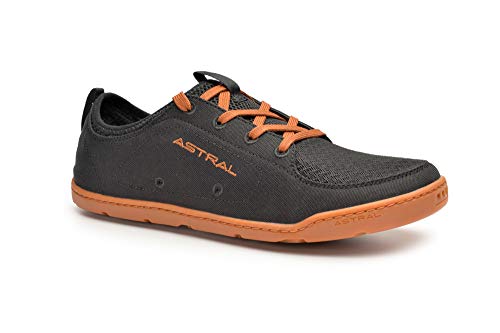 Men’s · Astral
Astral Loyak — Men
View on Amazon ↗Low-profile water sneaker for paddling and shore use.
Consider: Less cushioning than a structured walking shoe.
Questions about this topic
Are fishing water shoes hook-proof?
Ordinary water shoes are not. Do not infer puncture protection from an enclosed upper or toe bumper.
Can I use the same shoes for boat fishing and wading?
Sometimes the conditions overlap, but often they require different footwear. Evaluate deck rules and wading conditions separately.
Why clean shoes between fishing spots?
They can carry mud and organisms. Follow local invasive-species instructions, including any required decontamination.
Name the fishing platform before choosing the shoe. Keep specialist wading needs separate from casual water footwear, and include cleaning in the plan for every change of waterbody.
Use the water shoe finder →Continue your research
For a broader comparison, use our water shoes finder and catalog.